
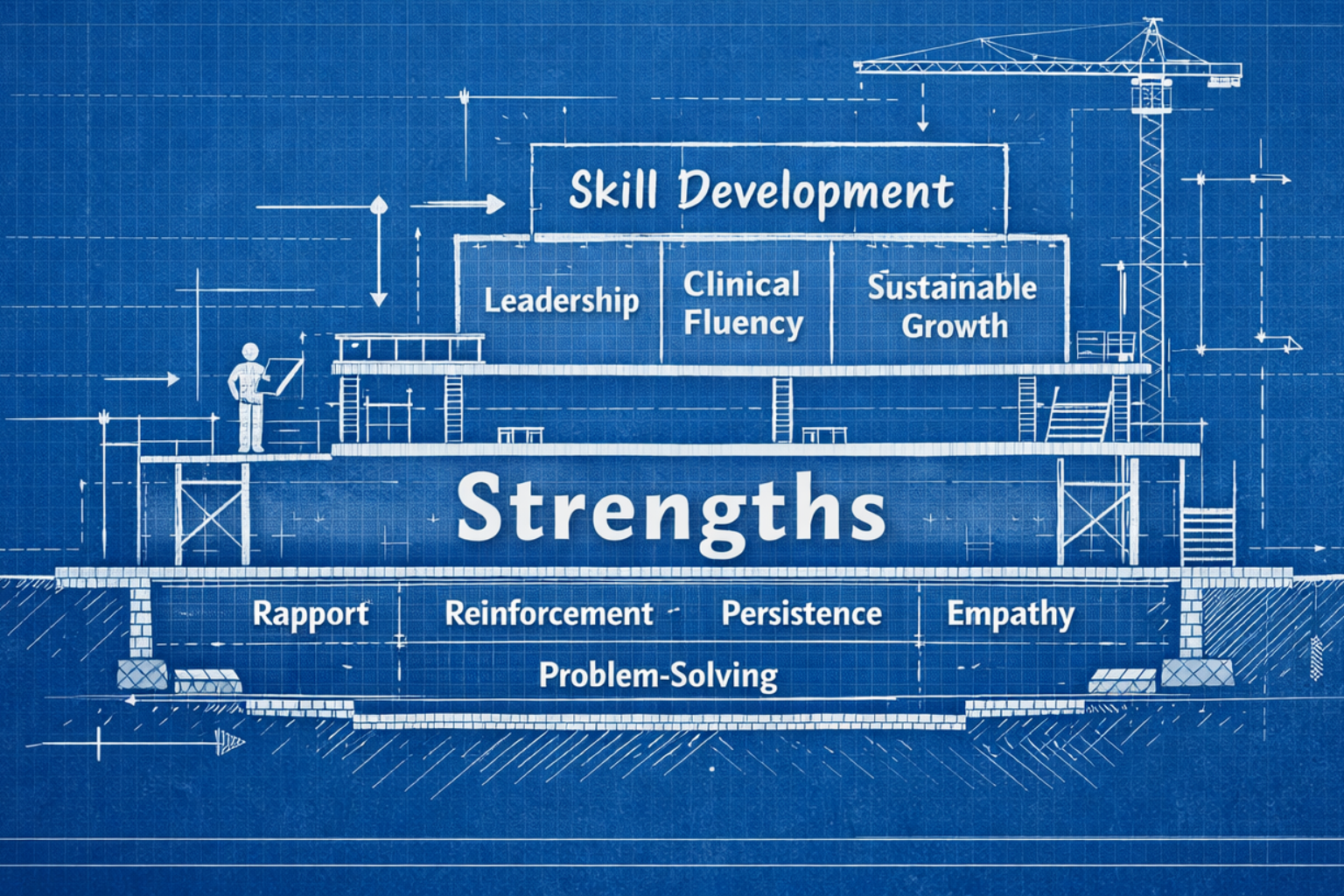
Reinforcing growth at every layer of service delivery: from supervision to intervention to long-term outcomes.
As Board Certified Behavior Analysts (BCBAs), we are trained to analyze behavior, identify skill deficits, and design intervention plans that help shape our clients’ behavior in ways that let them live their best lives.
During the Functional Behavior Assessment (FBA), we often ask caregivers and clients, when appropriate, about strengths as well as areas of concern. We gather information about preferences, existing skills, communication abilities, and environmental support. While our plans may focus on reducing problem behavior, we do not ignore strengths. We rely on them.
At Apple Tree Connection, our Strengths-Focused Clinical Model™ challenges a subtle default in our field: beginning with what’s missing. Instead, we ask behavior analysts to apply the same analytical precision to what’s already working - in themselves, in their clients, and in their supervisees. Strengths-based practice isn’t about minimizing challenges; it’s about intentionally building the behaviors we want more of.
In this article we will explore how.
Step 1: Apply the Lens to Yourself First
Before you bring a strengths-based mindset into supervision or behavior planning, pause and apply it to your own professional development.
Ask yourself:
You are your own best case study. When BCBAs experience the power of strengths-based reflection personally, they’re far more equipped to model it professionally. This is especially critical when navigating:
These barriers serve as signals to dive deeper. Before any meaningful growth can occur, there must be self-acceptance. For behavior to change, in ourselves or others, we must first acknowledge current skills, limitations, and circumstances exactly as they are. Acceptance is rooted in self-assessment. And accurate assessment is the foundation of effective intervention. Think of it as collecting baseline data on yourself.
Then, focus on improving deficits with replacement behavior already in your repertoire. Instead of reflecting on, “What’s wrong with me?” Switch to, “What need is going unmet, and what strength can help me address it?” Think of this as your own non-judgemental functional assessment.
Taking this one step further, gratitude shifts the emotional context of growth. When we become grateful for the strengths we already possess, and even for the challenges shaping our development as a practitioner, we reduce resistance and increase psychological flexibility. Gratitude changes the reinforcement value of the moment, and that is part of our own establishing operation.
Step 2: Reframe Challenging Behavior Through a Strengths Lens
In clinical work, our documentation often begins with skill deficits and behavioral excesses (e.g. Client engages in task refusal, Tantrum baseline = 30 minutes). A strengths-focused approach leans into these questions:
Leaning into strengths provides leverage to fill the deficits and reduce the excesses with replacements. Some behaviors may already be in their repertoire. Others may have approximations that can be shaped. Strengths create momentum. Momentum builds skill.
When behavior plans incorporate existing competencies, we often see:
Step 3: Use ABA to Teach ABA
When it comes to supervision, we expect RBTs to:
But are we using those same principles in how we train and mentor them? Using a strengths-focused supervision model you can ask:
Instead of supervision that always feels corrective, we create supervision that feels developmental. And we lean into mentorship. This allows us to:
BCBAs can learn how to run strengths assessments, and how to train RBTs to conduct strengths assessments with clients. This creates a systems-level shift that embeds strengths into the culture of supervision, training, and clinical decision-making.
Over time, this becomes a reinforcement culture - one in which effort, skill acquisition, professional growth, and client strengths are systematically noticed and strengthened. When reinforcement is intentional at every level, performance improves because of alignment.
Step 4: Build Skills Without Building Burnout
Burnout isn’t always about caseload size. Often, it’s about misalignment between expectations and strengths. When we build professional growth around natural competencies including: creativity, structure, empathy, data analysis, systems thinking, we reduce friction. Burnout prevention is not just about workload reduction; it is about reinforcement balance. When clinicians operate primarily from deficit-correction, effort feels depleting. When growth is built from strengths, effort becomes sustainable.
Ask yourself daily, and help your supervisees ask themselves:
The Clinical Takeaway
A strengths-based approach elevates a BCBA’s clinical thinking and grounds their practice in precision, behavioral alignment, and long-term sustainability. From this foundation you can:
✅ Reframe challenging behavior strategically
✅ Design behavior plans rooted in existing competencies
✅ Supervise RBTs using reinforcement-based leadership aka mentorship
✅ Support growth without overwhelm or burnout
✅ Walk away with immediately usable strategies
When we use ABA to shape strengths in ourselves, our supervisees, and our clients, we create environments where growth is reinforced.
Created by AppleTree Connection ~ Rooted in the Strengths-Focused Clinical Model™
As Board Certified Behavior Analysts (BCBAs), we are trained to analyze behavior, identify skill deficits, and design intervention plans that help shape our clients’ behavior in ways that let them live their best lives.
During the Functional Behavior Assessment (FBA), we often ask caregivers and clients, when appropriate, about strengths as well as areas of concern. We gather information about preferences, existing skills, communication abilities, and environmental support. While our plans may focus on reducing problem behavior, we do not ignore strengths. We rely on them.
At Apple Tree Connection, our Strengths-Focused Clinical Model™ challenges a subtle default in our field: beginning with what’s missing. Instead, we ask behavior analysts to apply the same analytical precision to what’s already working - in themselves, in their clients, and in their supervisees. Strengths-based practice isn’t about minimizing challenges; it’s about intentionally building the behaviors we want more of.
In this article we will explore how.
Step 1: Apply the Lens to Yourself First
Before you bring a strengths-based mindset into supervision or behavior planning, pause and apply it to your own professional development.
Ask yourself:
- What do I consistently do well as a clinician?
- When do I feel most confident in my leadership?
- What environments, systems, or routines help me thrive?
- Where do I naturally create momentum?
You are your own best case study. When BCBAs experience the power of strengths-based reflection personally, they’re far more equipped to model it professionally. This is especially critical when navigating:
- Burnout
- Career transitions
- Performance reviews
- Leadership growth
- Imposter syndrome
These barriers serve as signals to dive deeper. Before any meaningful growth can occur, there must be self-acceptance. For behavior to change, in ourselves or others, we must first acknowledge current skills, limitations, and circumstances exactly as they are. Acceptance is rooted in self-assessment. And accurate assessment is the foundation of effective intervention. Think of it as collecting baseline data on yourself.
Then, focus on improving deficits with replacement behavior already in your repertoire. Instead of reflecting on, “What’s wrong with me?” Switch to, “What need is going unmet, and what strength can help me address it?” Think of this as your own non-judgemental functional assessment.
Taking this one step further, gratitude shifts the emotional context of growth. When we become grateful for the strengths we already possess, and even for the challenges shaping our development as a practitioner, we reduce resistance and increase psychological flexibility. Gratitude changes the reinforcement value of the moment, and that is part of our own establishing operation.
Step 2: Reframe Challenging Behavior Through a Strengths Lens
In clinical work, our documentation often begins with skill deficits and behavioral excesses (e.g. Client engages in task refusal, Tantrum baseline = 30 minutes). A strengths-focused approach leans into these questions:
- When does this client thrive?
- What skills already exist that we can build from?
- What environments increase independence?
- Where do we see persistence, creativity, or motivation?
Leaning into strengths provides leverage to fill the deficits and reduce the excesses with replacements. Some behaviors may already be in their repertoire. Others may have approximations that can be shaped. Strengths create momentum. Momentum builds skill.
When behavior plans incorporate existing competencies, we often see:
- Increased buy-in
- Reduced resistance
- Greater generalization
- More sustainable progress
Step 3: Use ABA to Teach ABA
When it comes to supervision, we expect RBTs to:
- Deliver reinforcement effectively
- Shape behaviorFade prompts
- Build independence
But are we using those same principles in how we train and mentor them? Using a strengths-focused supervision model you can ask:
- What does this RBT already do well in session?
- Where do they show natural rapport?
- What clinical skills come easily to them?
- How can I reinforce effort and delivery, not just correct errors?
Instead of supervision that always feels corrective, we create supervision that feels developmental. And we lean into mentorship. This allows us to:
- Shape clinical excellence gradually
- Reinforce precision
- Build fluency in implementation
- Increase confidence and retention
BCBAs can learn how to run strengths assessments, and how to train RBTs to conduct strengths assessments with clients. This creates a systems-level shift that embeds strengths into the culture of supervision, training, and clinical decision-making.
Over time, this becomes a reinforcement culture - one in which effort, skill acquisition, professional growth, and client strengths are systematically noticed and strengthened. When reinforcement is intentional at every level, performance improves because of alignment.
Step 4: Build Skills Without Building Burnout
Burnout isn’t always about caseload size. Often, it’s about misalignment between expectations and strengths. When we build professional growth around natural competencies including: creativity, structure, empathy, data analysis, systems thinking, we reduce friction. Burnout prevention is not just about workload reduction; it is about reinforcement balance. When clinicians operate primarily from deficit-correction, effort feels depleting. When growth is built from strengths, effort becomes sustainable.
Ask yourself daily, and help your supervisees ask themselves:
- What strength did I rely on today?
- Am I building a skill, or just reacting to a barrier?
- What small step tomorrow aligns with the clinician I want to become?
The Clinical Takeaway
A strengths-based approach elevates a BCBA’s clinical thinking and grounds their practice in precision, behavioral alignment, and long-term sustainability. From this foundation you can:
✅ Reframe challenging behavior strategically
✅ Design behavior plans rooted in existing competencies
✅ Supervise RBTs using reinforcement-based leadership aka mentorship
✅ Support growth without overwhelm or burnout
✅ Walk away with immediately usable strategies
When we use ABA to shape strengths in ourselves, our supervisees, and our clients, we create environments where growth is reinforced.
Created by AppleTree Connection ~ Rooted in the Strengths-Focused Clinical Model™
Tara Zeller is the founder of AppleTree Connection
©2026 The AppleTree Connection All Rights Reserved